Aqui podemos ver bien la evolución del famoso algoritmo por ejemplo metiendole una matriz de 5x5.
http://www.gregthatcher.com/Mathematics/GaussJordan.aspx
Da lo mismo hacer ceros en cada una de las columnas dejando en cada columna un solo uno que hacer ceros por debajo de la diagonal principal y una vez hecho esto hacer ceros por encima de la diagonal principal.
León-Sotelo
viernes, 8 de junio de 2007


jueves, 7 de junio de 2007
Enteros consecutivos
The number of ways in which n may be expressed as a sum of one or more consecutive positive integers is equal to the number of positive odd divisors of n.
50! = 2^47 × 3^22 × 5^12 × 7^8 × 11^4 × 13^3 × 17^2 × 19^2 × 23^2 × 29 × 31 × 37 × 41 × 43 × 47
Divisores impares:23*13*9*5*4*3*3*3*2^6=93.000.960 formas de expresar 50! como suma de enteros consecutivos.
http://www.nzmaths.co.nz/PS/L5/Secondary_Units/consecnumbers.aspx
http://www.nzmaths.co.nz/PS/L5/Algebra/JacksonsCon.aspx
http://mathforum.org/library/drmath/view/55979.html
http://www.uam.es/personal_pdi/ciencias/ehernan/Talento/MercheSanchez/Problema%20numeros.pdf
http://centromatematico.uregina.ca/mp/previous2002/feb03sol.html
http://www.qbyte.org/puzzles/p092s.html
http://nrich.maths.org/public/viewer.php?obj_id=507&part=solution
50! = 2^47 × 3^22 × 5^12 × 7^8 × 11^4 × 13^3 × 17^2 × 19^2 × 23^2 × 29 × 31 × 37 × 41 × 43 × 47
Divisores impares:23*13*9*5*4*3*3*3*2^6=93.000.960 formas de expresar 50! como suma de enteros consecutivos.
http://www.nzmaths.co.nz/PS/L5/Secondary_Units/consecnumbers.aspx
http://www.nzmaths.co.nz/PS/L5/Algebra/JacksonsCon.aspx
http://mathforum.org/library/drmath/view/55979.html
http://www.uam.es/personal_pdi/ciencias/ehernan/Talento/MercheSanchez/Problema%20numeros.pdf
http://centromatematico.uregina.ca/mp/previous2002/feb03sol.html
http://www.qbyte.org/puzzles/p092s.html
http://nrich.maths.org/public/viewer.php?obj_id=507&part=solution
miércoles, 6 de junio de 2007
Euler totient
Si mcd(a,m)=1 entonces a^fi(m)=1 mod m
Hallar los dos ultimos digitos de N=17^19^23^29^31^37.
17^19^23^29^31^37 (mod 100) fi(100)=40
19^23^29^31^37 (mod 40) fi(40)=16
23^29^31^37 (mod 16) fi(16)=8
29^31^37 (mod 8) fi(8)=4
31^37 (mod 4) fi(4)=2
37 (mod 2) fi(2)=1 Ahora procedemos al revés:
37=1 (mod 2)
31^37 =31^1=31=3 (mod 4)
29^31^37 =29^3=5^3=5 (mod 8)
23^29^31^37= 23^5=7^5= 7 (mod 16)
19^23^29^31^37 = 19^7=19 (mod 40)
17^19^23^29^31^37 =17^19= 53 (mod 100) que son los dos ultimos digitos
León-Sotelo
Hallar los dos ultimos digitos de N=17^19^23^29^31^37.
17^19^23^29^31^37 (mod 100) fi(100)=40
19^23^29^31^37 (mod 40) fi(40)=16
23^29^31^37 (mod 16) fi(16)=8
29^31^37 (mod 8) fi(8)=4
31^37 (mod 4) fi(4)=2
37 (mod 2) fi(2)=1 Ahora procedemos al revés:
37=1 (mod 2)
31^37 =31^1=31=3 (mod 4)
29^31^37 =29^3=5^3=5 (mod 8)
23^29^31^37= 23^5=7^5= 7 (mod 16)
19^23^29^31^37 = 19^7=19 (mod 40)
17^19^23^29^31^37 =17^19= 53 (mod 100) que son los dos ultimos digitos
León-Sotelo
martes, 29 de mayo de 2007
Cartesian coordinate systems
Lo mejorcito de la red respecto a ejes coordenadas esféricas, cilíndricas etc... lo tienen los de teleco en Sevilla justo en la cátedra de Antonio Gonzalez:
http://laplace.us.es/campos/teoria/teoria.php
Polares: http://tutorial.math.lamar.edu/AllBrowsers/2414/PolarCoordinates.asp
Esféricas: http://www.gr.ssr.upm.es/eym/www/eym1/sld0014.htm
Cilíndricas:http://www.gr.ssr.upm.es/eym/www/eym1/sld0011.htm
Translación y rotación de ejes:
http://es.wikipedia.org/wiki/Coordenadas_cartesianas#Traslaci.C3.B3n_del_origen
http://www.azc.uam.mx/cyad/procesos/website/cursos/INTER/1Transformación.htm
Orden: Si B^2-4AC=0 primero rotación y después translación.Si B^2-4AC<>0 lo hacemos a la inversa.B es el término en xy.
Pappus Guldin:http://www.cpgec.ufrgs.br/morsch/mecanica/aula/a13.pdf
Nabla Gradiente y Rotacional:
http://dieumsnh.qfb.umich.mx/vector/operador_nabla.htm
León-Sotelo
http://laplace.us.es/campos/teoria/teoria.php
Polares: http://tutorial.math.lamar.edu/AllBrowsers/2414/PolarCoordinates.asp
Esféricas: http://www.gr.ssr.upm.es/eym/www/eym1/sld0014.htm
Cilíndricas:http://www.gr.ssr.upm.es/eym/www/eym1/sld0011.htm
Translación y rotación de ejes:
http://es.wikipedia.org/wiki/Coordenadas_cartesianas#Traslaci.C3.B3n_del_origen
http://www.azc.uam.mx/cyad/procesos/website/cursos/INTER/1Transformación.htm
Orden: Si B^2-4AC=0 primero rotación y después translación.Si B^2-4AC<>0 lo hacemos a la inversa.B es el término en xy.
Pappus Guldin:http://www.cpgec.ufrgs.br/morsch/mecanica/aula/a13.pdf
Nabla Gradiente y Rotacional:
http://dieumsnh.qfb.umich.mx/vector/operador_nabla.htm
León-Sotelo
sábado, 26 de mayo de 2007
Miscelanea
Un nombre premier n'a que deux facteurs : 1 et lui-même.
Un nombre composé a plus de deux facteurs.
Le nombre 1 n'est ni un nombre premier, ni un nombre composé.
Hablando de Taylor:
The degree is the degree of the polynomial, and the order is the order of the derivative
El cero no tiene mas que un múltiplo.El propio cero
mismo.Es múltiplo de cualquier número.Es múltiplo universal
El 1 no tiene mas que un divisor.Él mismo.
El 1 divide a cualquier número.Es divisor universal.
Abs (x)=distancia de x al origen.Así Abs(0)=0
Abs(x)= x si x>=0
Abs(x)=-x si x<0
http://www.fmat.cl/index.php?act=attach&type=post&id=15384
(meter contraseña leonsotelo magdalena)
http://www.sosmath.com/algebra/solve/solve3/s34/s34/s34.html
http://regentsprep.org/REgents/mathb/7D8/absinequal.htm
http://www.sci.wsu.edu/~kentler/Fall97_101/nojs/Chapter2/section6.html
http://www.dma.fi.upm.es/docencia/primerciclo/calculo/grupo11m-1/feb00sol.pdf
Si de todos modos hubiera problemas partimos la inecuación en trozos segun sus valores significativos y vamos probando in
tervalo por intervalo.Lo mas comodo es aquí claro:
http://www.hostsrv.com/webmab/app1/MSP/quickmath/02/pageGenerate?site=quickmath&s1=inequalities&s2=solve&s3=basic
Division by cero is Undefined. 0/0 is indeterminate, 1/0 is undefined
Un nombre composé a plus de deux facteurs.
Le nombre 1 n'est ni un nombre premier, ni un nombre composé.
Hablando de Taylor:
The degree is the degree of the polynomial, and the order is the order of the derivative
El cero no tiene mas que un múltiplo.El propio cero
mismo.Es múltiplo de cualquier número.Es múltiplo universal
El 1 no tiene mas que un divisor.Él mismo.
El 1 divide a cualquier número.Es divisor universal.
Abs (x)=distancia de x al origen.Así Abs(0)=0
Abs(x)= x si x>=0
Abs(x)=-x si x<0
http://www.fmat.cl/index.php?act=attach&type=post&id=15384
(meter contraseña leonsotelo magdalena)
http://www.sosmath.com/algebra/solve/solve3/s34/s34/s34.html
http://regentsprep.org/REgents/mathb/7D8/absinequal.htm
http://www.sci.wsu.edu/~kentler/Fall97_101/nojs/Chapter2/section6.html
http://www.dma.fi.upm.es/docencia/primerciclo/calculo/grupo11m-1/feb00sol.pdf
Si de todos modos hubiera problemas partimos la inecuación en trozos segun sus valores significativos y vamos probando in
tervalo por intervalo.Lo mas comodo es aquí claro:
http://www.hostsrv.com/webmab/app1/MSP/quickmath/02/pageGenerate?site=quickmath&s1=inequalities&s2=solve&s3=basic
Division by cero is Undefined. 0/0 is indeterminate, 1/0 is undefined
En las ecuaciones funcionales la sustituciones de x=>(por otro valor) se realizan siempre en la primera ecuación funcional
Ordered pairs of positive integers (a,b) it means the order matters when we list the pairs. In other words (3,1) is different from (1,3).
Recuerda que si n es par la fórmula correcta es
(a^n)^(1/n) = a para n par o sea sqrt((-3)^2)=-3=3
sqrt(p) es irracional si p no es un cuadrado perfecto
p^(1/n) es irracional si p no es una potencia n-esima
Pentagrama y Phi
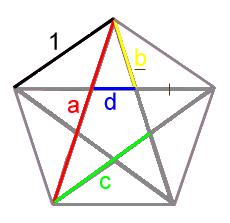
In this next figure (pinchar enlaces de abajo) is a regular pentagon with an inscribed pentagram.All the line segments found there are equal in length to one of the five line segments described below:The length of the black line segment is 1 unit.The length of the red line seqment, a, is Ø. The length of the yellow line seqment, b, is 1/Ø. The length of the green line seqment, c, is 1, like the black segment. The length of the blue line seqment, d, is (1/Ø)2, or equivalently, 1 - (1/Ø), as can be seen from examining the figure. (Note that b + d = 1).
http://kjmaclean.com/Geometry/PentOverview.html
Ver:http://i113.photobucket.com/albums/n205/leonsotelo/pentagramratios.gif
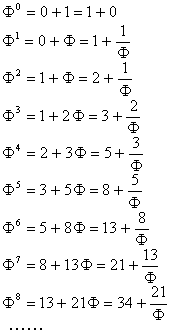
Aqui tenemos las potencias de Phi:
http://i113.photobucket.com/albums/n205/leonsotelo/fipot.gif
Y aqui historias de Phi,Fibonacci,... para no perderselo
http://www.mcs.surrey.ac.uk/Personal/R.Knott/Fibonacci/propsOfPhi.html#powers
León-Sotelo
http://kjmaclean.com/Geometry/PentOverview.html
Ver:http://i113.photobucket.com/albums/n205/leonsotelo/pentagramratios.gif
Aqui tenemos las potencias de Phi:
http://i113.photobucket.com/albums/n205/leonsotelo/fipot.gif
Y aqui historias de Phi,Fibonacci,... para no perderselo
http://www.mcs.surrey.ac.uk/Personal/R.Knott/Fibonacci/propsOfPhi.html#powers
León-Sotelo
viernes, 25 de mayo de 2007
Ceva, Menelao,Ptolomeo,Cateto...
Ceva:http://agutie.homestead.com/files/ceva.htm
Menelao:http://agutie.homestead.com/files/menelaus1.htm
Ptolomeo1:http://agutie.homestead.com/files/geometry_help_online.htm
Ptolomeo2:http://www.math.rutgers.edu/~zeilberg/PG/Ptolemy.html
Stewart:http://planetmath.org/encyclopedia/ProofOfStewartsTheorem.html
Geometria:http://agutie.homestead.com/files/geometry_help_online.htm
Cateto:http://www.terra.es/personal/rogero/trazado/prop_dir.htm
Aqui pongo una generalizacion n-dimensional para el teorema del cateto
y de Pitágoras:
http://descartes.cnice.mecd.es/m_Geometria/t_cateto/index.htm
León-Sotelo
Menelao:http://agutie.homestead.com/files/menelaus1.htm
Ptolomeo1:http://agutie.homestead.com/files/geometry_help_online.htm
Ptolomeo2:http://www.math.rutgers.edu/~zeilberg/PG/Ptolemy.html
Stewart:http://planetmath.org/encyclopedia/ProofOfStewartsTheorem.html
Geometria:http://agutie.homestead.com/files/geometry_help_online.htm
Cateto:http://www.terra.es/personal/rogero/trazado/prop_dir.htm
Aqui pongo una generalizacion n-dimensional para el teorema del cateto
y de Pitágoras:
http://descartes.cnice.mecd.es/m_Geometria/t_cateto/index.htm
León-Sotelo
Suscribirse a:
Entradas (Atom)